Friday, May 10, 2013

Dynamo-powered lights, part 2

New setup

Now that I've been riding with my dynamo hub a while, I'll give you the update I promised seven months ago.

I've replaced the headlight with a more powerful model. I did this not because I was dissatisfied with the B&M headlight. I was perfectly satisfied with it. A friend was placing an order with xxcycle in France, and he gave me a chance to add to it. I got a good deal on this light, and I figured the B&M could go on my wife's bike or another bike of mine. The B&M is rated at 40 Lux, and this Philips is rated at 60 Lux. It also has a white reflector which faces forward. I'm pretty sure I notice the increase in output, and that's a good thing. I think I have hit a speed of about 25 mph on an unlit road, and I was comfortable at that. That says a lot. Going faster than that on an unlit road is a luxury, not a necessity, at least to me.

In this picture, you see the headlight attached to a front rack on the bike. I attached a metal bracket to the rack and the light to the bracket. 


This resulted in too much bouncing up and down. I could have stiffened it, but I decided I didn't need the rack at all, so now the headlight is attached to the fork in the traditional way.


I've devised my own wiring system. I used little lugs to attach to the hub. The wires from the lugs go to a female DC power connector. This allows for quick removal and replacement of the wheel. I have a vision of a wiring setup which would allow easy removal and replacement of the lights, rather than having them permanently mounted and wired. That is a future project, which I might or might not do. As it is currently, I can attach different lights to a different bike, and if I use the same kind of connector on the other bike, I can move this wheel from this bike to the other bike, provided they use the same size wheel. This is a 700c wheel with 32mm-wide tires, and many bikes use wheels like that. Most of my bikes use 700c wheels.

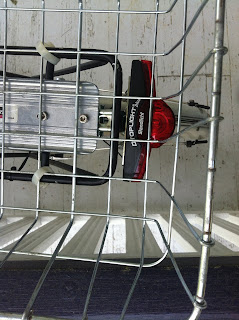
The taillight is attached to the rear rack.


Wiring goes from the hub, up the fork, to the headlight, out of the headlight, up the head tube, and wrapped around the brake cable which runs along the top tube. From there it runs under the rear rack and to the taillight.


The DC connectors are the type used for powering CCTV cameras. I soldered the connections and use heat-shrink tubing for permanent insulation.

Operation

The hub has no on/off switch. The drag increases as electrical load increases. With no load, the drag is noticeable to the fingers but not in the riding of the bike. With one light or both lights on, the drag goes up, but I still don't notice it on the bike. At high speed, I feel a slight vibration at the handlebar. It's not annoying, especially since I know what causes it.

The taillight also has no on/off switch, so it runs unless I don't connect the hub's wiring.

The headlight has an on/off switch, but since drag seems negligible, and since having a headlight on during the day might be a useful thing, I just leave it in the on position.

It's easy to adjust the headlight's up/down position while riding the bike. The bolt that holds the light to the bracket allows me to make it possible to turn it on the horizontal axis without letting the light flop on that axis from vibration. I'm sure this is deliberate, and I appreciate it. If there is significant oncoming traffic, I point the light slightly down so it doesn't shine in people's eyes. If the road is dark and has little traffic, I'll point it up a bit more so I can light up the road farther ahead.

The lights flash when I'm moving at low speed. This is a side effect of the output of the dynamo. I believe all bike dynamos put out alternating current, so the voltage reaches zero a few times a second, at a rate proportional to rotational speed. The flashing might be a good thing, or it might be a neutral thing. It doesn't bother me, and I don't think it bothers anyone else, either, since battery-powered flashing lights are so common here in the US. They may even be more common than continuously lit lights.

Overall impression

This setup is so good that I prefer to use this bike whenever I need to ride anywhere. I know that the light will have power, and I don't have to mind the charging state of any batteries. If I ride for longer than expected, there is no battery to run down. I expect that this system will need far less maintenance per mile than nearly any battery-powered system. One reason is, of course, that I'm providing the power. Another is that the system is permanently mounted to the bike. One advantage is that I may not want to lock this bike up in areas where thieves like to grab whatever they can off bikes parked in public.

Still to do

The wiring for the headlight is too long, since the headlight was farther forward when it was on the front rack. For the time being, the excess is looped around inelegantly. I plan to shorten and neaten this part of the wiring. While I'm at it, I should shorten the cable on the fork and the wheel.

As I mentioned, I might enable quick removal and re-installation of the lights. This will be better for locking the bike in public, and I might be able to move the lights from one bike to another.

Materials used

Tuesday, October 9, 2012

Dynamo-powered lights, part 1

Considering that Europeans commute by bike a lot more than North Americans do, I thought using their collective wisdom on bike lights could help. Generally, North Americans prefer battery-powered lights, whereas Europeans prefer dynamos (aka generators). Someone whose word I trust tells me that Germany requires fender-mounted lights to be dynamo-powered. In other words, battery-powered lights are illegal.

Also, Germany has many regulations about what bike lights must do and must not do. They specify the shape that the light beam must have, and they specify minimum and maximum brightness. Since bike lights are required for a great many bike commuters in Europe, and since most bike commuters take the requirements seriously, high quality lights are mass produced and widely available in Europe.


Long ago, I took a bike tour in Europe which lasted for three months. Before I left, I equipped my bike with a dynamo and lights. The system worked reliably, without my ever having to make changes, adjustments, or repairs. This memory, combined with the points in my preceding paragraphs, made me realize that dynamo powered lights would be good for me. The purchase price can be high, but it might end up being a better value than batteries.


A generous friend gave me a Sanyo H27 dynamo hub as a gift. Building wheels is something I enjoy a great deal, so the chance to build a wheel out of this was a plus, not a burden.


I bought my lights on http://www.xxcycle.com, which is a French web site. They offer an English version of their site, and you can have the prices displayed in US dollars and other currencies. Their prices are low enough that, even with the shipping cost, I saved money, compared with buying the lights from one of the few sources in the US. The headlight is a Busch & Müller IQ Fly R Senso + (174SNDI). The output is rated at 40 Lux, which is a different scale than lumens. The beam pattern is odd. The lens creates two beams. One is very short and very wide. The other reaches and spreads ahead, illuminating the road. This latter beam is oddly rectangular-shaped. I'm sure there's a rationale for the German regulation requiring this, but it doesn't bother me nearly as much as it amuses me.


I haven't installed the tail light yet.


Europeans do not use flashing headlights or tail lights, and I don't feel the need for one.


The lights have a "standlight" (aka standlicht) feature whereby they stay on even after the bike stops moving. They accomplish this by putting a capacitor in each light. I'm grateful for this. The headlight also has an "auto" mode where it lights up when it is sufficiently dark outside but not when it's light. I haven't tested this. I have decided that a "daytime running light" might prove to be useful, and the cost of running it is negligible.


Speaking of cost, I should talk about the energy required to light my lights. As I've said, I haven't installed the tail light. The headlight's electrical causes the dynamo hub to increase the drag that it creates, however, I can't perceive this load while riding. In other words, the energy requirement from my body is low enough that it's nearly free. That may change when I add the tail light, but I doubt it. At high speeds, I can feel a vibration in the handlebars, but it doesn't bother me.


I've felt comfortable traveling on very dark roads at speeds of up to 25 mph. This is quite fast on a bicycle. I can accomplish this speed only going downhill. I can go faster than that in the day, but it's a generous enough speed that I don't feel very restricted. In other words, the light makes me feel quite secure in traffic.


This post is part one. Part two will feature more pictures, a description and report of the tail light, plus mention of my other approaches to safety at night.

Monday, December 19, 2011

My Commute

I am going to devote a few pages to the bike I commute on. It is my main bike. I ride it every work day. I didn’t build it myself; it’s something I bought new. I have modified it quite a bit, to make it into the ideal commuting machine. But before I get into the details of the bike, I have to describe my commute, which will explain the specific requirements of my commuter bike.

I didn't build it myself. I have had to make various modifications to it, though, that have made it unique. But that uniqueness is what mystifies me the most about this bike. If I didn't have this bike, I would get another one just like it, and make the same modifications. If I were the bicycling industry, I would sell these. But no one does. Another commuter I know, who has similar requirements (except that he doesn't require a folding bike), bought his bike in Switzerland. It's a Trek (an American company) but this model isn't sold here. Apparently there's no market for it. I just don't get that.

Anyway, as I say, this is my commuter bike. I really don’t have any other way of getting to work. The bike is my car. The family car is more or less my wife’s, though I drive it sometimes. I don’t have a car. I have this bike. I’m not complaining. I’m proud of my bike.

I work in Manhattan, about sixty miles from home, and to get there I ride my bike to the train station, fold up the bike and get on the train where I sit, often unconscious, for an hour. Then the real fun begins: playing in traffic! Now, I’ve seen traffic in Rome, Istanbul, Jerusalem, Aleppo, Tunis, and other interesting places. So I’m not going to complain about New York City traffic. It’s really pretty civilized in comparison. But let’s face it, riding a bike up Eighth Avenue, between all the taxis at Port Authority Bus Terminal, and through the joggers and dog walkers of Central Park, is not for the faint of heart. This is technical cycling. I eventually stop for coffee, walk the rest of the way to my office, Later that day I reverse the whole process, without coffee. It works out to about 21 miles on the bike, 110 miles on the train. For every hour I spend at my job, I spend a half hour getting there. And I know that sounds like a lot, but the half hour spent getting there is more fun than the hour spent working, so I can’t complain.

People ask, how I get to work when I don't ride my bike. Answer: I don't go to work when I can't ride my bike there. I really don't have another way of getting there. But that is a choice I've made; after all, I suppose I could drive. If I had a car –in addition to my wife’s car, that is—I could drive to the station, park in the garage there, ride the train without my bike, then walk to the subway, ride the subway, and walk the rest of the way. Getting to the station, even after parking, would save me about five minutes, allowing me to leave home five minutes later and arrive home five minutes earlier. Walking and taking the subway in the city would cost mefive or ten minutes each way, so would reduce my work day a little bit. So driving would save a little time, and cost quite a bit of money between the expense of a second car, gas, parking (it’s not cheap), and subway fare. Some people may think this would improve my quality of life; I don’t.

Working these kinds of hours means part of my ride is in the dark all year round, and all of my ride is in the dark at this time of year (December).

So here are the few basic requirements I have for my bike:
--It has to fold up compact enough to fit on the train.
--it has to have lights good enough that riding in the dark is as safe as riding in light.
--it has to have fenders, so I can ride on wet roads without getting road grime splattered all over myself.
--it has to be robust enough that I can beat the crap out of it every day without doing much maintenance.
--And, finally, it has to be a decent bike, one that I’m willing to ride every day, keep up with Manhattan traffic, and that kind of thing.

I'll admit that all of these requirements are flexible to some degree. The first one, about how it folds up, for example: I ride a commuter train that duriing rush hours allows only bikes that fold up. They don’t tell you how well or how small or how fast the bike folds up; they only require THAT it folds up. A bike that folds up, but poorly, is allowed; but I’d have to sit in the area reserved for handicapped riders or luggage. To sit near the bike, in those locations, I’d have to sit in a seat that folds down. That’s not good enough for me; I can’t relax in those seats, and so I can’t sleep there. If the bike folds up small enough that I can put it on an overhead rack, I can sit anywhere on the train. If the bike folds up small enough that I can stash it between the seats, that works too. But I spend two hours on the train every day. I want to be able to relax, and sleep, in that time.

Saturday, December 3, 2011

pedal straps

I've been using toe clips with straps for years, and even dabbled in "clipless" pedals --SPD and Look-- for a while, but I can't say I'm really thrilled about any of them. I recently picked up an old bike, a Raleigh Lenton Sports from 1951, that needed something on the pedals, but I just couldn't face another pair of toe clips. So...


I cut up an old tire and made these straps. And guess what: I like them!

Friday, December 2, 2011

Review: Bianchi Volpe


I just came upon a used Bianchi Volpe in bad shape. The brakes barely work, and the shifters don't work at all. We'll see if I can bear my amazing mechanical skills upon it to make it a worthy rider. I don't know what years it is. It has Shimano RSX dérailleurs. The saddle is of "cutout" type, which my doctor say will be kind to my perineum. I test rode it in the parking lot of a McDonald's on a highway. That seemed more dangerous than riding on the highway. People back out of their parking spaces without looking back. Well, it's Noo Joizy.

It has one of those saddles with a cut-out, and my doctor recommended one to me for the sake of my perineum. Interestingly, it doesn't feel any different from saddles without cutouts, and I think my doctor might be right.

Welcome to the DIM Bicycle


Welcome to the DIM Bicycle!

DIM stands for "Did It Myself", which is the way our bicycles are.....Done by Ourselves. 

There's so many ways to build up a bicycle and we'll explore all the possibilities we can.  Old, New, Racer, Commuter, Cruiser, Tourer, Grocery Getter, Utility, Tandems, Anachronisms and Oddities.....we love em all.

You'll see builds, custom fabrications, homebrews and kludges....sit back and enjoy the ride!